

Open user management
User management lives in the Users section of Settings, under the Organisation group in the left nav rail.1
Open Settings
Click your avatar in the top-right corner and select Organisation.
2
Open Users
In the left nav rail, select Users under Organisation.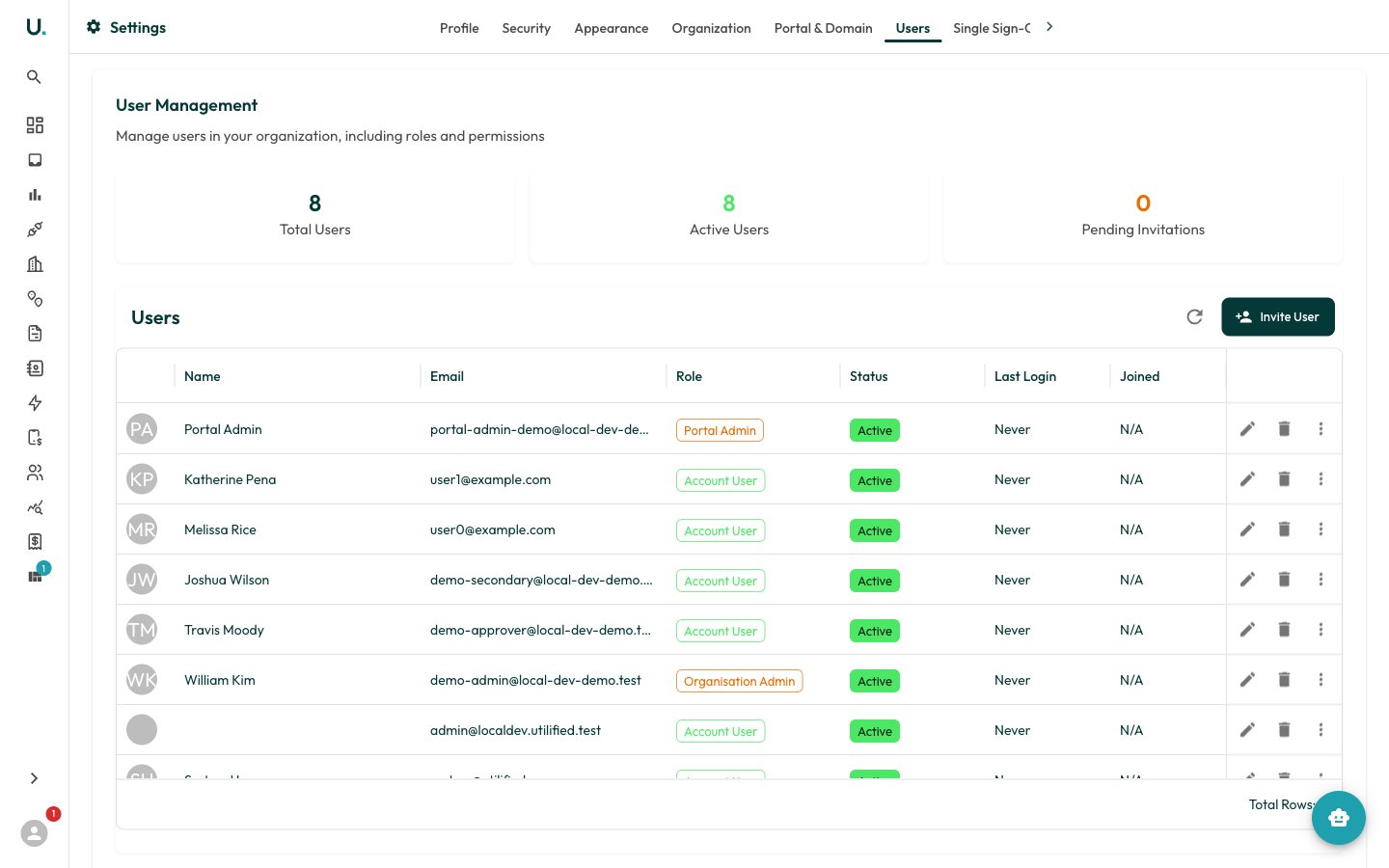
Invite a new user
1
Start an invitation
Click Invite User in the top-right of the Users card. This opens the Invite New User wizard.
2
Enter user details
On the User Details step, enter the new user’s First Name, Last Name, and Email Address. The invitation is sent to the email address you enter here. Phone Number is optional.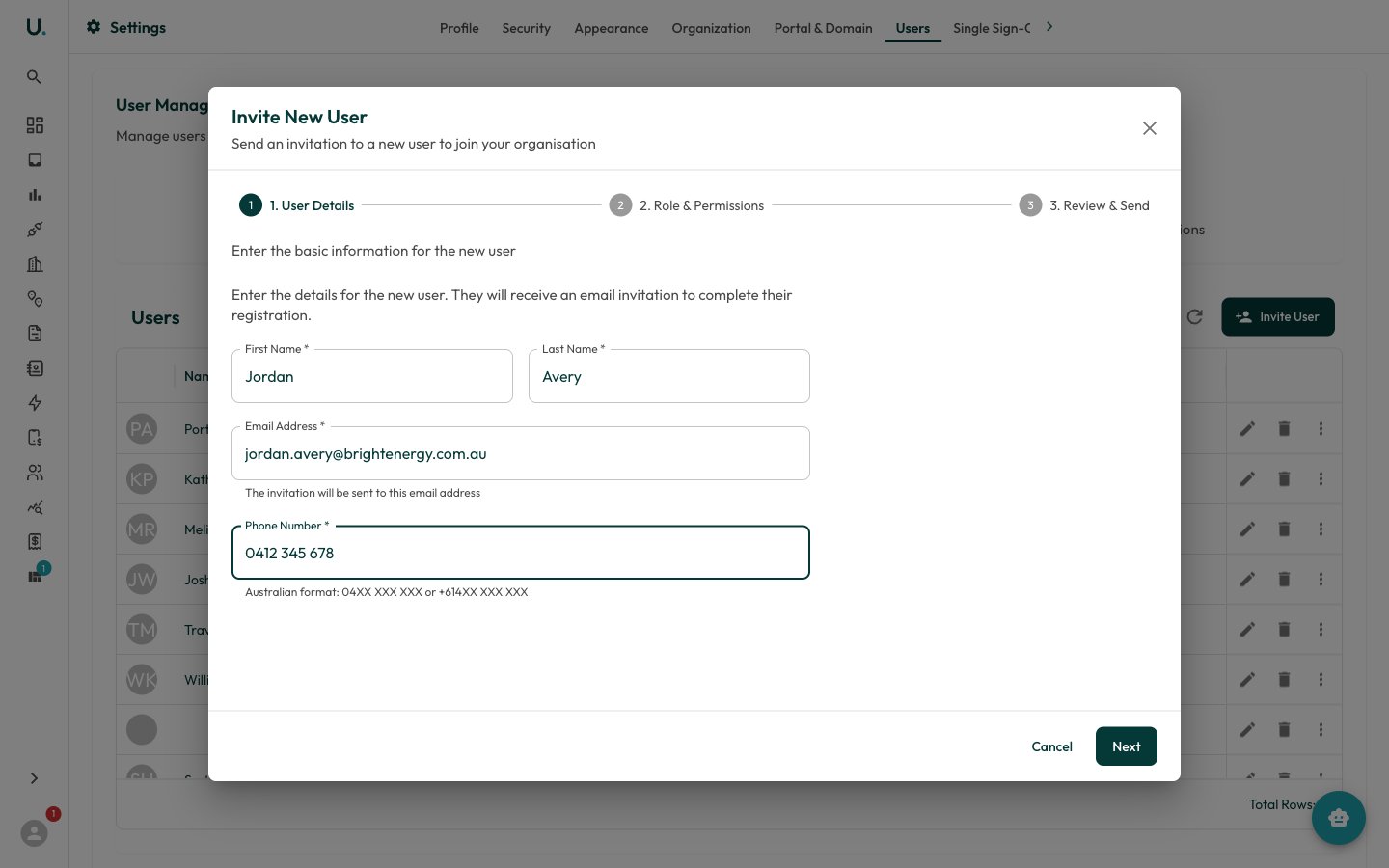
If you enter a phone number, Australian format is preferred —
04XX XXX XXX or +614XX XXX XXX.3
Choose a role
Click Next to move to Role & Permissions, then pick a role from the curated role cards. The list is filtered to your own privilege level — you can only invite users at or below your role (Superuser and above are never offered). The permissions preview shown next to each card is fetched from the backend, so it always reflects what the role can actually create, read, update, and delete across each application.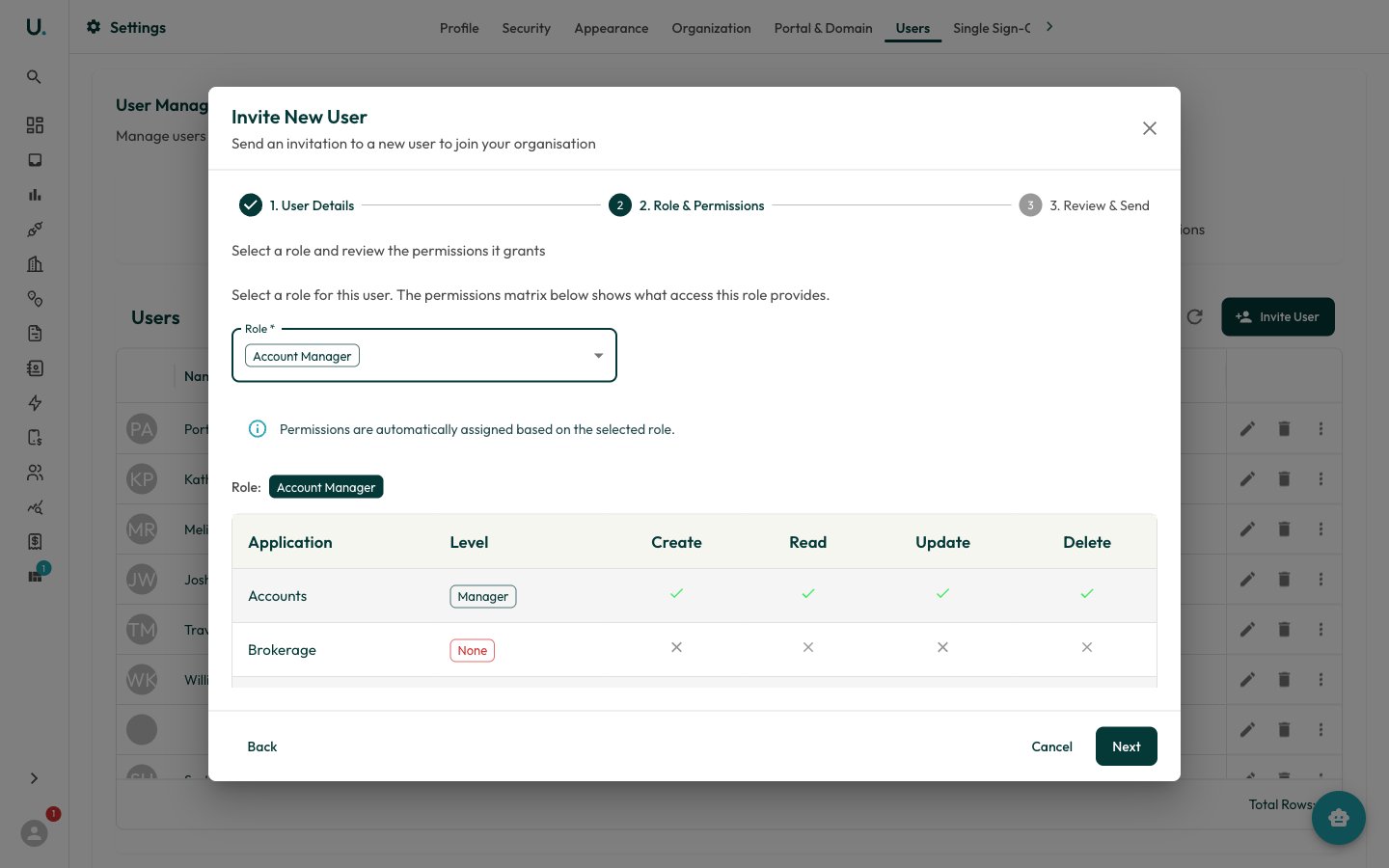
4
Set account access (account-scoped roles only)
If the role you picked is account-scoped — Portal Admin, Portal User, Account User, or Account Viewer — the wizard adds an Account Access step where you choose the account(s) the user should be scoped to. This step is skipped for organisation-wide roles. It’s the same picker that appears on the Account Access tab of the edit dialog for existing users.
5
Review and send
Click Next to reach Review & Send. Check the summary, then click Finish to send the invitation. The new user receives an email to complete their registration and set a password.
User roles
The role you choose controls what the user can access. UMS provides the following roles:
Only roles at or below your own privilege level appear as cards in the wizard.
Manage existing users
Each row in the users table has actions for managing that user:- Edit user — Update their name, role, Active status, and which accounts they can access (on the Account Access tab, which uses the same picker as the wizard’s Account Access step).
- Resend invitation — Re-send the registration email to a user whose invitation is still pending.
- Deactivate user — Revoke access immediately without deleting the account. Use Reactivate user to restore it.
- Delete user — Permanently remove the user. This cannot be undone.
A user with a pending invitation shows a Pending Invitation status until they complete registration, after which they appear as Active.